Is Passivhaus Certification Worth It?
Why We Recommend Certification for Every Projects
As architects, we are often asked why certification matters. “Isn’t it enough to design responsibly, specify carefully, and aim high?” When I speak with homeowners or local authorities, my answer is straightforward: aspiration sets the direction, but verification delivers the impact.
Importantly, the Passivhaus certification process ensures a building doesn’t just claim exceptional performance — it demonstrates it. Independent assessment, rigorous modelling, and on-site testing confirm that the design intent actually becomes reality. That difference matters, whether you’re a homeowner investing in long-term comfort and efficiency or a local authority accountable for measurable environmental outcomes.
Certainty of Performance and Quality, Not Just Compliance
- Proven reductions in space heating/cooling demand;
- Evidenced savings on total energy demands;
- Measured airtightness performance;
- Verified thermal continuity, comfort year round;
- Fully designed, balanced and commissioned mechanical ventilation with heat recovery delivering consistent indoor air quality, at proven quiet sound levels.
Certification is a quality assurance process, crucially, it checks what was we design is actually built.
For homeowners, this means confidence that energy bills will reflect design expectations. For local authorities, however, it provides reassurance that approved schemes genuinely contribute to carbon reduction targets rather than relying on theoretical calculations. Post‑occupancy research from universities consistently demonstrates that Passivhaus does what it says on the tin.
This disciplined approach aligns closely with the environmental principles promoted here at Eco Design Consultants. We emphasise robust fabric-first design, measurable energy reduction and long-term performance resilience. Interestingly, build regulations is taking on many of the Passivhaus checks such as requiring photographic evidence, and more rigorous testing.
Comfort as a Design Priority
As architects, we design for people first. One of the most compelling aspects of Passivhaus certification is its unwavering focus on comfort.
In both new build and retrofit projects, certification demands that we eliminate cold bridges, draughts and temperature fluctuations. The result is an interior environment where:
- Temperatures remain stable throughout the year;
- Overheating risk is carefully modelled and mitigated;
- Fresh, filtered air is supplied continuously;
- Moisture movement is managed and mould risk is dramatically reduced.
Homeowners quickly recognise the difference. Living in a certified building is not simply about lower bills — it is about quietness, even warmth and healthier indoor air.
For local authorities, this directly addresses wider public health objectives. Warm, dry homes reduce the social costs associated with fuel poverty and poor indoor environmental quality.
New Builds: Setting a Clear Benchmark
In new build projects, certification establishes clarity from the outset. The performance targets shape design decisions early — influencing orientation, glazing ratios, fabric specification and detailing.
Consequently, by committing to certification, we strenghten the entire process:
- First, we minimise performance gaps between design and construction;
- Next, we ensure coordination across architectural and engineering disciplines;
- Finally, we deliver buildings that are future-ready in the face of tightening regulation.
For planning authorities, certified schemes demonstrate leadership and provide a tangible example of sustainable development in action. For homeowners, they represent long-term value and resilience against rising energy costs. With increased accuracy and confidence, the design can be more finely tuned providing additional value.
Retrofit: Raising the Bar Where It Matters Most
If new builds offer opportunity, retrofit, on the other hand, presents responsibility. The majority of the UK’s 2050 building stock already exists. Deep retrofit — particularly to EnerPHit (the Passivhaus retrofit standard) — provides a structured and credible pathway to substantial energy reduction.
Retrofit certification ensures that upgrades are not superficial. Instead, they are holistic and carefully sequenced:
- Fabric insulation is optimised without compromising building integrity;
- Airtightness improvements are tested and verified;
- Moisture risk is assessed and controlled;
- Ventilation strategies are designed to safeguard long-term performance.
For local authorities concerned with heritage, conservation and embodied carbon, this approach respects existing structures while dramatically improving operational efficiency, whilst greatly reducing risks and adding value.
For homeowners, it transforms older, uncomfortable buildings into healthy, low-energy homes without losing character.
Case Study: St Peter’s Place, Canterbury
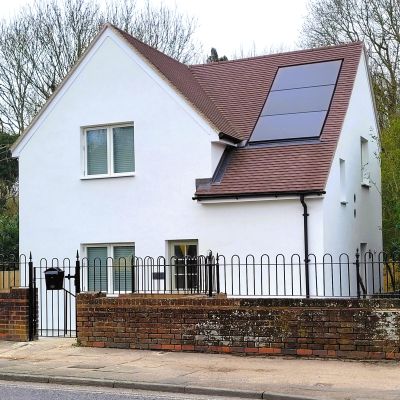
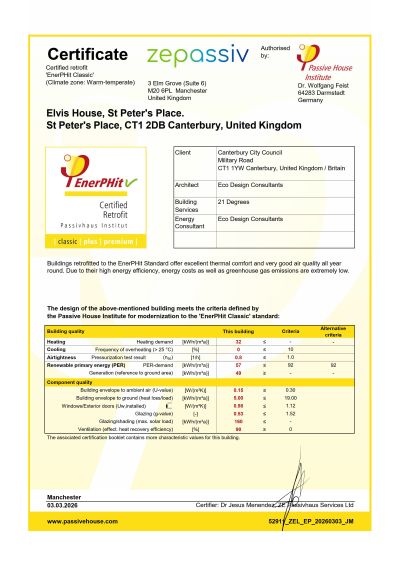
A recent example of this approach is the certified Passivhaus retrofit at St Peter’s Place in Canterbury — known locally as the “Elvis House”.
Notably, this project demonstrates that ambitious performance standards are achievable even within an existing building envelope. Through meticulous detailing, fabric enhancement and careful coordination with the certifier, the project now delivers verified reductions in energy demand alongside exceptional internal comfort.
“As the architect on this project I believe that ultimately certification, reduces risks and gives certainty on performance, giving real value. As architects this gives us confidence and a second pair of eyes that what we design is realised, and our clients achieve the comfort and wellbeing they deserve.”
– Alan Budden
For homeowners considering deep retrofit, this project illustrates what is possible. For local authorities, it provides a working example of measurable carbon reduction within an urban context.
Why Certification Matters to Both Audiences
Ultimately, from our perspective as architects, certification serves two essential purposes:
- It protects the client’s investment, reduces risk and provides value.
Performance is independently verified, providing a rigorous QA process. - It supports policy ambitions with evidence.
Local authorities can rely on certified outcomes to demonstrate meaningful progress towards climate commitments.
Ultimately, certification is not about prestige. It is about accountability, rigour and delivering buildings that genuinely perform as designed.
In both new builds and retrofit projects, Passivhaus certification ensures that sustainability is not simply discussed — it is demonstrated.